
Tuesday, June 27, 2006, 12:45 AM - log
many of you have written to me about the Blender --> PureData HOWTO i wrote up last year and how you've used it in your own projects. it's great to see this simple tute forming the basis of a few workshops and university classes now also (here's looking at you Andy!).it seems the Wiretap site is currently down - and has been for a while. for this reason you'll probably be missing an essential ingredient of the tutorial, the pyKit Python -> OSC interface libraries.
because i'm very nice, i've archived them here until they're back online.
| permalink
Sunday, June 25, 2006, 08:55 PM - howtos
Beagle is an 'instant search' tool for Linux systems, and normally works in conjunction with the Gnome Desktop, which I don't run. being able to instantly find files from the commandline is thus something i've wanted for a while. here's a simple howto for those of you that'd like instant search from the CLI. it assumes you have a Debian based system:
sudo apt-get install beagle
create a beagle index directory:
mkdir ~/.beagle-index
index all of $HOME:
sudo beagle-build-index --target ~/.beagle-index --recursive ~/
start the beagle daemon as $USER. it automatically backgrounds:
beagled
run 'beagle-query' in the background so that it looks for live changes to your indexed file system.
beagle-query --live-query &
now create a file called 'foobar' and search for it with:
beagle-query foobar
the result should instantly appear.
it may be better to alias it as 'bfind' or something in ~/.bashrc and start 'beagled' and 'beagle-query --live-query &' from ~/.xinitrc or earlier.
enjoy
Friday, June 2, 2006, 12:58 PM - live

it's in the Ogg Theora format (plays with VLC), is 84M slim and has a couple of minutes playing time.
this video is pretty much a record of the piece as it was exhibited at Lovebytes06, the game autoplaying continuously for two weeks.
there is no human input in this work, four bots fight each other, dying and respawning, over and over again. one of the four bots sends all of it's control data to PD which in turn is used to drive a score. it's through the ears of this bot that we hear the composition driven by elements such as global-position in the map, weapon-state, damage-state and jump-pad events. For this reason game-objects and architectural elements were carefully positioned so that the flow of combat would produce common points of return (phrases) and the orchestration sounded right overall.
The scene was heavily graphically reduced so as to prioritise sound within the sensorial mix.
we have a multichannel configuration in mind for the future, whereby each bot is dedicated a pair of channels in the mix. the listener/audience would then stand at the center. perhaps we would remove video output altogether, so that all spatial and event perception was delivered aurally.
get it here.
Thursday, May 25, 2006, 11:41 PM - live
it's 40M and in the Ogg Theora format. if you don't know what that means just use the VLC player.
get the video here.
if you can deal with Flash, here's a YouTubed version.
Sunday, May 14, 2006, 02:16 AM - dev

thanks to a generous commission from Cybersonica, pix and I had the resources we needed to throw a month at creating an entirely new version of fijuu, the engine, artwork and audio got a complete overhaul.
development in such a short period of time was also testimony to the power of skype as a collaboration tool. we spent around 8-10 hours in the IM each day sending each other patches, artwork, code snippets etc right up until the point of walking out the door with Fijuu and Ubuntu on a shiny new Shuttle. if only Skype or an equivalent IM and VoIP tool had code-formatting and an sketch-block with drawing tools and SVG export..
the piece was installed at Phonica in London where it'll be on show until the 26th, alongside sister shows around London.
here are some screenshots of the finished work and most imporantly here's the sourcecode if you're at all interested in compiling it:
pix has put together a README listing dependencies. don't leave home without it!
darcs pull http://fijuu.com/darcs
Thursday, April 13, 2006, 07:21 PM - howtos

fellow Kiwi Adam Hyde just sent through some snaps of a little workshop conducted in Lotte Meijer's house in Amsterdam over the snowy new-year.
we spontaneously decided to make TV transmitters according to a plan devised by Tetsuo Kogawa, a mate of Adam's. Adam and Lotte had the gear, so we got busy.
Marta, Adam, Lotte and I each soldered a board up, but Lotte's worked the best. the board has a little variable resistor for tuning channels and to our complete astonishment gave us a near perfect colour reception with a composite cable from a DVCam hardwired onto the board. we got around 10m of range between the transmitter and the TV before the signal was lost due to occlusions in the house itself. with a few boosters used in serial this range would be (hypothetically) exponential.
fun and games - build one yerself!
Monday, March 27, 2006, 12:53 AM - live

Thursday, February 16, 2006, 05:07 AM - dev
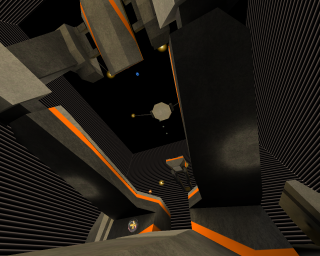
Thanks to Ed Carter and the Lovebytes folk, q3apd is finally getting a good showing in an installation context; to date it's largely been appreciated in a performance setting. Unlike prior appearances, q3apd will this time be played entirely by bots which is so far proving to be an interesting challenge.
While these bots are in mortal combat they are generating a lot of data. q3apd uses this data to generate a composition, in essense providing a means to 'hear' the events of combat as a network of flows of influence.
To do this, every twitch, turn and change of state in these bots is passed to the program PD where the sonification is performed; agent vectors become notes, orientations accents and local positions become pitch. Events like jumpads, teleporters, bot damage and weapon switching all add compositional detail (gestures you might say).
Once the eye has become accustomed to the relationships between audible signal and the events of combat, visual material can be sequentially removed with a keypress, bringing the sonic description to the foreground.
I've been working on a new environment for the piece and helping bots come to terms with the arena. Here's a preview shot. When the work goes live I'll post a video.
Monday, February 13, 2006, 02:58 AM - live
videos in bed, 2005.

Monday, February 13, 2006, 01:00 AM - dev
Ljubljana, 2005

Thursday, February 2, 2006, 10:42 PM - dev
i've been working on a series of moving images designed for use on very large screens.
anagram 1

this composition takes about 10 minutes to complete a cycle and runs indefinitely. it's called "anagram 1" and is designed as an 'recombinational' triptych. it is not interactive in any way.
this is the binary [2.5M]. it runs on a Linux system with graphic acceleration. just run 'anagram1' after unpacking the archive.
here's a small gallery of screenshots.
anagram 2

"anagram 2" takes much longer than the previous work to complete a cycle and spreads the contents of three separate viewports from one to the next to create complex depths of field. using orthoganal cameras, cavities compress and unfold as the architecture pushes through itself. the format of anagram2 is also natively larger.
here's the binary [2.4M]. it runs on a Linux system with graphic acceleration. run 'anagram2' after unpacking the archive.
here's a gallery of anagram 2.
Thursday, February 2, 2006, 10:18 PM - dev
2002-3

q3apaint uses software bots in Quake3 arena to dynamically create digital paintings.
I use the term 'paintings' as the manner in which colour information is applied is very much like the layering of paint given by brush strokes on the canvas. q3apaint exploits a redraw function in the Quake3 Engine so that instead of a scene refreshing it's content as the software camera moves, the information from past frames it allowed to persist.
As bots hunt each other, they produce these paintings. turning a combat arena into a shower of gestural artwork.
The viewer may become the eyes of any given bot as they paint and manipulate the brushes they use. In this way, q3apaint offers a
symbiotic partnership between player and bot in the creation of artwork.
The work is intended for installation in a gallery or public context with a printer. Using a single keypress, the user can capture a frame of the human-bot collaboration and take it home with them.
Visit the gallery.
Thursday, February 2, 2006, 10:11 PM - code
Some fun to be had. To start with try this:
import ossaudiodev

from ossaudiodev import AFMT_S16_LE

from Numeric import *

dsp = ossaudiodev.open('w')

dsp.setfmt(AFMT_S16_LE)

dsp.channels(2)

dsp.speed(22050)

i = 0

x = raw_input("length: ")

x = int(x)

a = arange(x)

while 1:

        # between 200 and 600 is good

        while i < x:

                i = i +1

                b = a[i:]

                dsp.writeall(str(b))

                print i,":",x

        else:

                while i !=0:

                        i = i -1

                        b = a[i:]

                        dsp.writeall(str(b))

                        print i,":",x
Thursday, February 2, 2006, 10:10 PM - code
it's harder than you think!
here it is in python ported from some Java i found online.
Thursday, February 2, 2006, 10:10 PM - code
here's a wifi access point brower i wrote in python for Linux users that prefer to use console applications. i
'll get around to one that roams and pumps based on the best offer.
scent.py
Thursday, February 2, 2006, 10:09 PM - code
here's a little python script to let you know when your laptop battery is running low.
dacpi.py
Thursday, February 2, 2006, 10:08 PM - dotfiles
this rc resources pyzor, spamassin, procmail and gnupg.
~/.muttrc
Thursday, February 2, 2006, 10:07 PM - howtos

i've been playing around with creating little demo's in blender that explore it's limits for positional (3D) audio. as it goes the limits a
re near and not very interesting. regardless it's perfectly possible to create installations using point based audio. i'm working on a series of
these now. in the meantime here's a little HOWTO blender file..
PKEY in the camera window to play. ARROWKEYS to move, LMB-click and drag to aim (walk/aim stuff nicked from a blender demo file).
for those without blender, but just want to see the results, here is a Linux binary
. just make it executable (with KDE/Gnome or chmod +x file) and click or ./file to play.
Thursday, February 2, 2006, 10:07 PM - dev
2005

the first person perspective has always been priveledged with the pointillism (or synchronicity) of a physiology that travels with the will in some shape or form, "I act from where I perceive" and "I am on the inside looking out". in this little experiment however, you are on the outside looking in.
in this take on the 2nd Person Perspective, you control yourself through the eyes of the bot, but you do not control the bot; your eyes have effectively been switched. naturally this makes action difficult when you aren't within the bot's field of view. so, both you and the bot (or other player) will need to work together, to combat each other.
there is no project page yet, but downloads and more information are available here.
Thursday, February 2, 2006, 10:06 PM - dev
1999-2000

this was my first successful foray into the use of games as performance environments.
it project uses a modified QuakeII computer gaming engine as an environment for mapping and activating audio playback, largely as raw trigger events. it
works well both live and as an installation. I later implemented this project in Half-Life.
the project webpage, and movie are here.
back next


